

April 15th– Newsletter
Humics 101: Build your soil organic matter today for a stronger tomorrow
The term “humics” has been buzzing around agronomic circles lately, but it hasn’t quite yet made its way into everyone’s vocabulary. Simply put, “humics” are what makes dirt black. It is a general term to describe varying long, complex carbon chains found in soil, including humic acid, humin and fulvic acid.
All soils are made of weathered parent material, living organisms, air, water, and organic matter. On the Canadian prairies, that parent material comes from limestone‑rich sediments left behind by an ancient inland sea. Glaciers later ground up the calcitic shell and bone remnants, spreading those layers across the region. Because the prairies are semi‑arid, those carbon‑rich sediments never washed downward like they did in humid eastern climates. The result is the calcareous, high‑pH soils we farm today.
These soils are productive, but they come with quirks. Phosphorus, zinc, iron, and manganese tie up easily. Water infiltration can be limited. Crusting, compaction, solonetz, and salinity are common. The severity of these challenges is directly tied to soil organic matter.
What really is soil organic matter?
Soil organic matter isn’t just one thing. It’s three distinct pools of carbon working together to determine soil productivity potential.
- The active pool is the short-term food source for microbes, built and depleted quickly through residue, manure, and decaying plant roots. You can influence this season to season, but it functions a lot like fast food for microbes and is a not a long-term biology fueling strategy for nutrient cycling.
- The slow pool gives soil its structure and aggregation, changing much slower, over years and even decades. It is made of decomposed organic matter and living microbial biomass. This pool keeps nutrients in the profile so that the microbes (and later your plants) can slowly access them.
- And then there is the third passive humus pool — the dark, long-lived carbon that takes centuries to form and ultimately determines a soil’s water holding capacity, cation exchange capacity, pH buffering, and long-term productivity.
Humic substances fit into the last two pools: fulvic acids contribute to the slow pool, while humic acid and humin build the passive humus pool. If these pools take decades or centuries to change, why the renewed interest? Because humic acid, fulvic acid, and humin are now available as crop inputs.
Humalite: Alberta’s Prairie Soil Problem Solver
Most humic products on the market are sourced from leonardite, a partially oxidized coal-like substance formed in ancient saltwater environments. Leonardite varies widely in humic acid purity and activity, but Alberta has something noteworthily different to offer its humic-hungry producers.
Deep in the Palliser Triangle at Sheerness, AB coal miners uncovered a geological layer that looked like coal but didn’t burn like coal. It was darker and richer than leonardite. Testing revealed it was humalite— similar to leonardite but with much higher humic and fulvic acid concentrations and it was extremely low in heavy metals. It turns out that this was due to the unique percolation of fresh water through the carbon seam that only northern glaciers offered. Unlike leonardite, humalite is much more pure, highly soluble and low in ash. This is why Johnston’s Regenerative only recommends humic products derived directly from Alberta’s own Black Earth humalite mine— the world’s cleanest and most continuous source of humic substances.
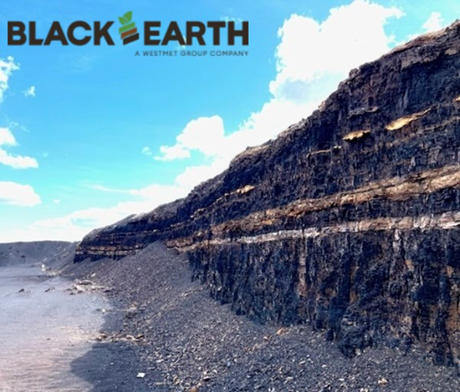
Above: Photo courtesy of Black Earth, showing a seam of humalite at their mine near Sheerness, AB.
How Humics Change the Game
Humic acids and humin from humalite directly reinforce the passive humus pool, improving soil structure, aggregation, and water retention. With humalite holding up to ten times its weight in water, this soil amendment gives crops a buffer in dry years and helps soils store more of every rainfall event.
The high concentration of humic acids also chelate tied-up nutrients, especially phosphorus, nitrogen and micronutrients, keeping them plant available longer. In calcareous soils where up to sixty percent of applied phosphorus can become fixed in the first year, this is a meaningful economic advantage; more of the fertilizer you already paid for actually reaches the crop.
Fulvic acids, the smaller and more mobile fraction, play a different but equally exciting role. They act as natural carriers, improving the uptake of nutrients, herbicides, and foliar products, while stimulating root growth and microbial activity. This contributes to that middle slow organic matter pool— the one that normally takes decades to influence— and supports stronger early vigor and more uniform crop development.
Together, these humic substances help prairie soils do what they were meant to do: hold water, cycle nutrients, support biology, and buffer against the extremes of our climate—without having to wait for the next glacier to form and recede. They don’t replace fertilizer or biology; they make both work better. And because humalite is so pure and so active, its effects show up quickly while also contributing to long-term soil resilience.
With seeding right around the corner Alberta’s own Black Earth humics company has granular and liquid humalite products designed for your farm’s unique needs. Contact your Johnston’s Regenerative professional agronomist to conduct a soil test and receive a complimentary Advanced Fertility ™ Recommendation with humic amendments included. Because in a region where every inch of moisture and every pound of fertilizer matters, humics aren’t just a buzzword — they’re a profitability tool.
