

How Regenerative Agronomy is Setting Farms Apart in 2026
Every growing season reveals the strengths—and weaknesses—of a farming system. In 2026, the challenges across much of the prairies include abundant moisture and cooler temperatures delaying crops, tying up nutrients, increasing disease pressure, and limiting access in wet fields. While these conditions have created tremendous yield potential, they’ve also created a season where resilience is becoming a competitive advantage.
As these stresses begin to stack together, an important question emerges: why are some fields maintaining their yield potential while others are struggling?
A REAL-WORLD TEST FOR REGENERATIVE AGRICULTURE
For years, regenerative agriculture has promised healthier soils, healthier plants, and more resilient cropping systems. This season is providing an opportunity to see those claims tested in real time—and the regenerative fields are becoming easier to spot from the road as the season progresses.
Producers and agronomists are noticing a difference between fields that are merely growing and fields that are thriving. The strongest-performing crops often share common characteristics: aggregated soil structure, robust root systems, improved water movement, greater biological activity, and more balanced nutrition.
These aren’t outcomes that appear overnight. They are the result of management decisions that have been building soil function over many seasons.
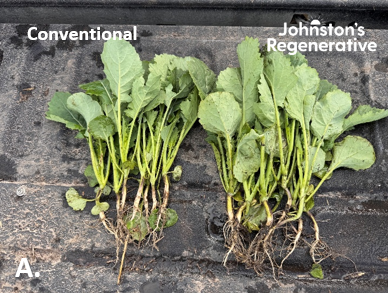
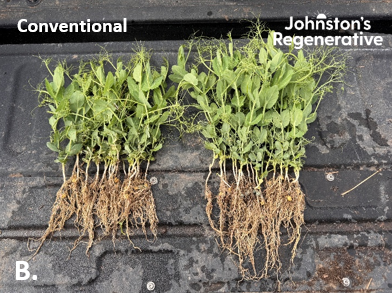
See the difference from the field edge. 2026 canola (A) and pea (B) crops with conventional farming practices on the left versus Johnston’s Regenerative programming on the right.
WHEN MOISTURE BECOMES A STRESS
Rain is usually viewed as a blessing on the prairies, but too much moisture can create challenges of its own. Saturated soils reduce oxygen availability in the root zone, slowing root activity and limiting nutrient uptake. In many fields this year, nutrients are present in the soil but are simply unavailable to the plant. Combined with cooler temperatures, these conditions can lead to nutrient deficiencies, uneven growth, and reduced crop vigor even when fertility levels appear adequate.
Fields with strong soil structure and active biology are better equipped to handle these abiotic stressors. Water moves through the macropores and micropores more efficiently, roots remain active longer, and crops are better positioned to recover once conditions improve.
PLANT HEALTH IS THE FIRST LINE OF DEFENSE
This season is also reminding producers that disease and insect pressures become more significant when crops are already under stress. Dense canopies and elevated humidity are creating favourable conditions for disease development across many regions, while insect monitoring programs continue to track economically important pests.
While healthy plants are not immune to disease or insects, they are often better able to tolerate and recover from stress. Crops with balanced nutrition, active root systems, and high photosynthetic capacity have more energy available for growth, repair, and recovery when challenges arise.
In other words, resilience begins long before the disease lesion or feeding damage appears. It starts with building a resilient soil system.
MANAGEMENT STILL MATTERS
Regenerative farming is not about hoping biology solves every problem.
Successful regenerative producers still scout fields, monitor insects and disease, test soils, evaluate plant nutrition, and make timely management decisions. The difference is that these tools are being used to support a strong biological foundation rather than compensate for a weak one.
This season has also highlighted the value of innovation. Recent regulatory changes allowing products registered for aerial application to also be applied by drone provide producers with another option when wet field conditions limit access with conventional equipment. Whether addressing disease pressure, correcting nutrient deficiencies, or protecting yield potential during critical growth stages, drone technology offers valuable flexibility when timing matters most to regenerative operations.
| THE BOTTOM LINE Regenerative agronomy isn’t about preventing stress; it’s about building the resilience to withstand it, recover from it, and remain productive through it. In a year like this, resilience is translating directly into profitability. |
WORKING WITH YOUR JOHNSTON’S REGENERATIVE AGRONOMIST
Participating in the Johnston’s Regenerative program gives you access to a complete agronomic system designed to identify yield-limiting factors before they become costly problems. From precision soil sampling and Advanced Fertility™ recommendations to tissue testing, sap analysis, in-season scouting, and customized field-specific recommendations, every service is focused on helping you understand exactly what is limiting crop performance and where the greatest return on investment can be achieved.
| READY TO BOOK A FIELD VISIT? Talk to your Johnston’s Regenerative Agronomist about tissue and sap sampling, custom foliar recommendations and in-season pest scouting. 1-844-324-7778 johnstonsregenerative.com |
